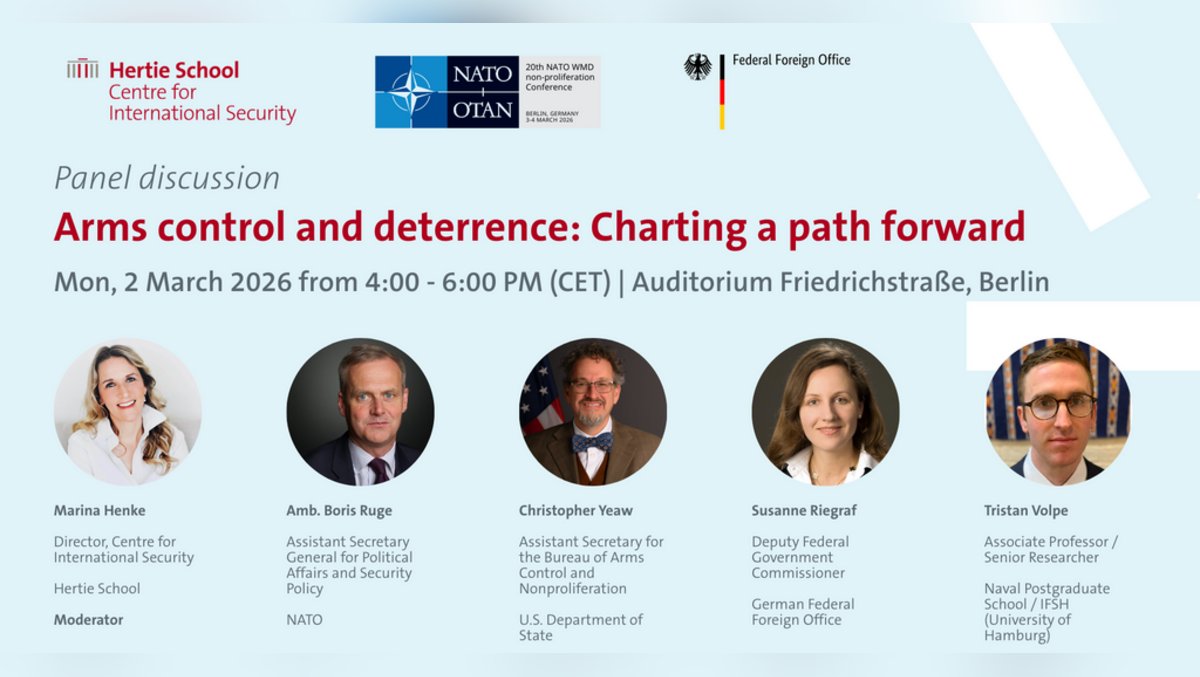
With nuclear risks rising, great-power competition intensifying, and the last pillars of the Cold War arms control framework beginning to crumble, can arms control still stabilise deterrence in a rapidly changing strategic landscape?
Arms control and deterrence have long served as critical mechanisms for managing nuclear risks and maintaining global strategic stability. However, the existing arms control architecture is now under severe strain. Russia has reverted to nuclear threats as tools of coercion, China is conducting its most rapid nuclear arsenal buildup in history, while Iran’s nuclear advances have prompted direct military action. Against this backdrop, New START, the last remaining US-Russia arms control agreement, has expired this year, and the upcoming NPT Review Conference will test whether the non-proliferation regime can adapt to these new realities.
This event will examine the future of arms control in the emerging strategic environment. The discussion will explore the role arms control can play in stabilizing deterrence relationships and how policymakers can balance the imperatives of deterrence and arms control in the new security landscape.
The Centre for International Security at the Hertie School, NATO, and the German Federal Foreign Office will co-host this discussion on the margins of the 20th NATO Conference on Weapons of Mass Destruction, Arms Control, Disarmament and Non-Proliferation taking place in Berlin.
Programme:
4:00 pm: Welcome by Cornelia Woll, President, Hertie School
4:15 pm: Panel discussion on arms control and deterrence: Charting a path forward
5:15 pm: Moderated Q&A
6:00 pm: End of event
Capacity for this event is limited. Please register to attend.