The DSA establishes a hybrid enforcement framework. The European Commission holds exclusive competence to supervise and enforce DSA obligations on Very Large Online Platforms (VLOPs) and Very Large Online Search Engines (VLOSEs). National authorities — Digital Services Coordinators (DSCs) — handle all other intermediaries established in their territory.
This centralized exclusive competence creates a real structural tension and dependency: raising the question: what legal options do EU Member States have if the Commission fails to do its job as as a supervisory and enforcement body?
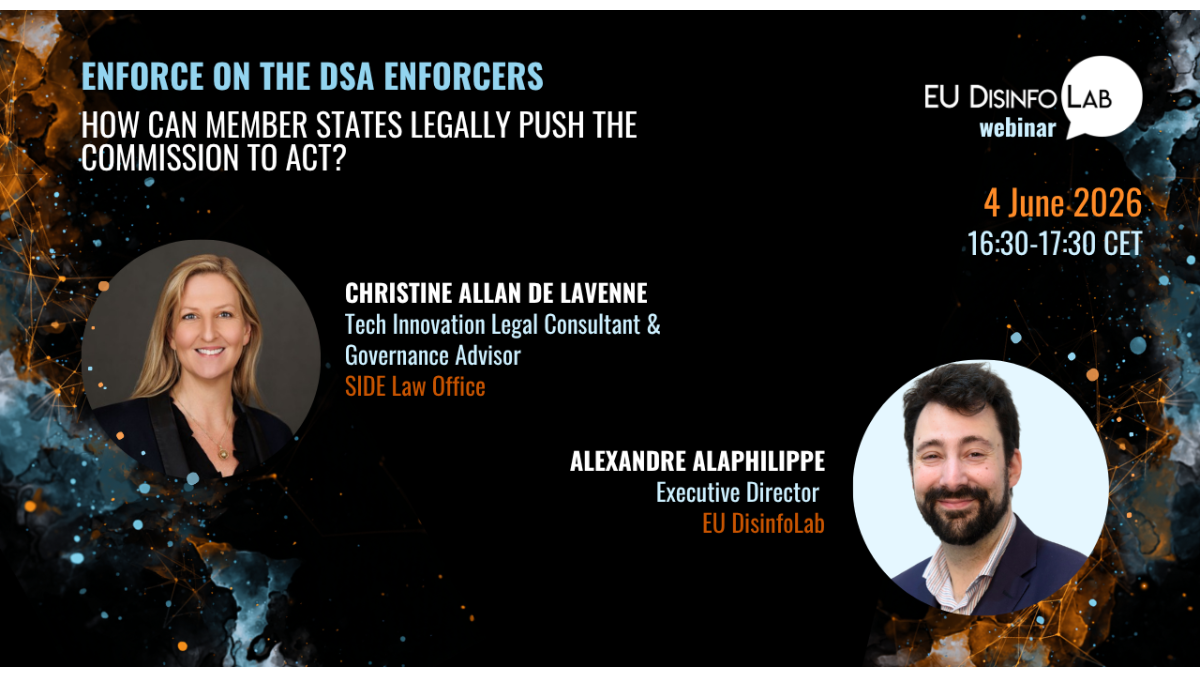
Welcome to join our discussion with Legal Consultant & Governance Advisor Christine Allan de Lavenne from SIDE Law Office!
Speaker: Christine Allan de Lavenne, Tech Innovation Legal Consultant & Governance Advisor
Christine Allan de Lavenne is a legal and policy executive operating at the intersection of freedom of expression, intellectual property, and emerging technology governance. With more than two decades of experience across Europe and the United States, she advises public institutions, NGOs, technology-driven organizations, and founders on navigating complex legal and regulatory environments where fundamental rights, innovation, and public accountability intersect.
Christine is the founding partner of SIDE Law Office and serves as an independent international tech innovation legal consultant and AI governance advisor. She advises NGOs, public bodies, and policy organizations on AI governance, information integrity, and cross-border regulatory strategy. Her work includes bridging international legal standards with the operational deployment of AI systems and contributing to policy initiatives addressing coordinated disinformation campaigns and their impact on democratic discourse and fundamental rights. Several of these contributions have informed government approaches and multilateral policy discussions.
Earlier in her career, Christine practiced media, intellectual property, and human rights law within leading European firms, supporting politically sensitive matters involving freedom of expression, reputation, and international human rights, as well as complex asylum and international criminal cases before French and international jurisdictions. She began her career at UNESCO, where she served as a Consultant in the Human Rights Division, coordinating the International Human Rights Forum and contributing to the organization’s human rights strategy across its member states.
Christine currently serves on and advises boards and initiatives focused on AI governance, digital trust, and information integrity. She is a dual U.S. and French citizen and is admitted to the Paris Bar.
Moderator: Alexandre Alaphilippe, Executive Director, EU DisinfoLab
Alexandre Alaphilippe is the Executive Director and co-founder of the EU DisinfoLab. Since 2017, he has coordinated work on some of the organisation’s largest investigations into Information Operations linked to Russia, India and China. In 2022, he led the exposure of Doppelganger, which has been labeled as one of the largest information operation from Russia in the past years. He is a member of a number of working groups in Brussels and Washington DC linked to platform regulation, transatlantic relations, and hybrid threats, where he emphasises the role of civil society in maintaining democratic values. He has published papers for the Brookings Institution and his work has been featured on CNN, BBC, Le Monde and Politico.
The opinions expressed are those of the speakers/authors and do not necessarily reflect the position of EU DisinfoLab. This webinar does not represent an endorsement by EU DisinfoLab of any organisation.