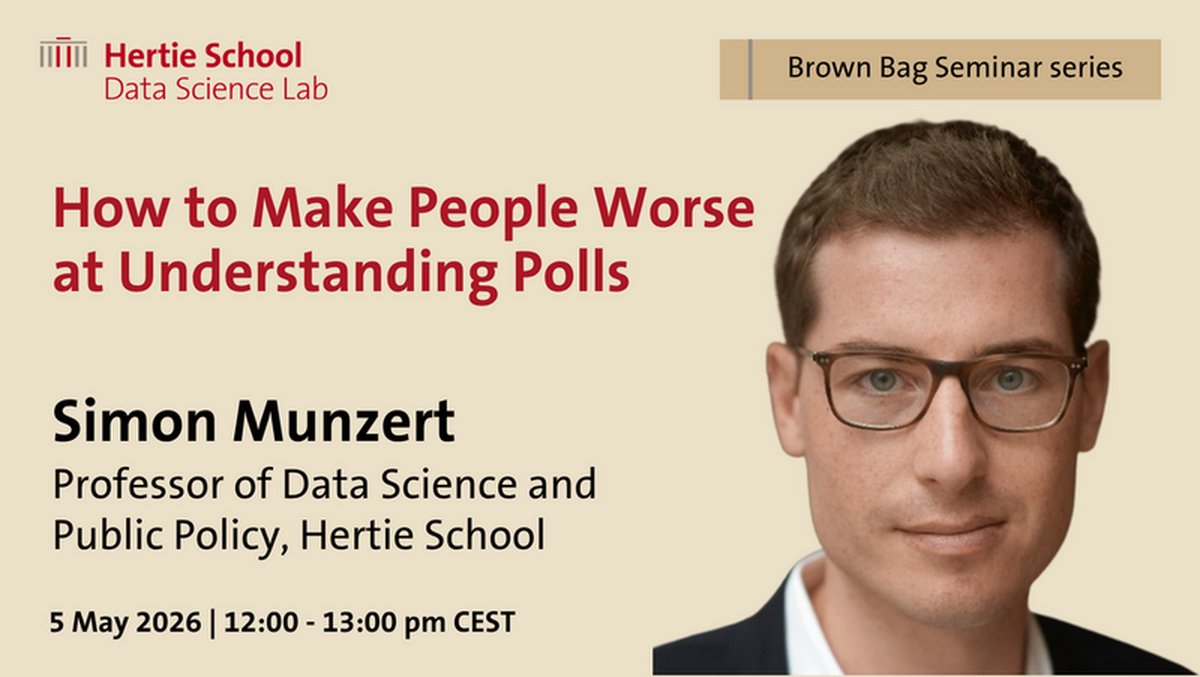
Join us for a Brown Bag Talk with Simon Munzert, Professor of Data Science and Public Policy at Hertie School.
Abstract from the speaker:
Election polls are among the most visible quantitative inputs into democratic deliberation, yet their production process remains opaque to most citizens. Without a working understanding of how polls are produced, people may place too much trust in flawed estimates or dismiss credible ones as biased – either way undermining the capacity of polls to meaningfully inform public debate. We build an interactive dashboard that simulates key pollster decisions – setting sample sizes, choosing recruitment methods, applying statistical weights – and evaluate its use in a pre-registered survey experiment (N = 52,765, fielded ahead of the 2025 German federal election). The intervention fails to achieve any of its three pre-registered objectives. It does not improve polling-related knowledge: aggregate effects are null, and while the dashboard teaches respondents that representative polls need not be enormous, it undermines their understanding of why statistical weighting matters. It does not foster more positive attitudes towards polls: perceived usefulness is unchanged, while treated respondents become more critical of polls‘ influence on politics. And it does not sharpen evaluative behavior: in a forced-choice conjoint task, treated respondents become less appreciative of weighting rather than more so. All effects are small in absolute terms, and our sample is large enough to be confident in this conclusion. These findings suggest that interactive tools can backfire when they lack pedagogical scaffolding, and that improving public understanding of polls is harder than building a better tool.
About the speaker:
Simon Munzert is Professor of Data Science and Public Policy at the Hertie School. He is the Director of the Hertie School Data Science Lab. His research interests include opinion formation in the digital age, public opinion, and the use of online data in social research. He is the principal investigator of an international cooperation project funded by the VolkswagenStiftung entitled „Paying Attention to Attention: Media Exposure and Opinion Formation in an Age of Information Overload“, and the recipient of a postdoctoral scholarship awarded by the Daimler and Benz Foundation. He received his Doctoral Degree in Political Science from the University of Konstanz. GitHub | Google Scholar | ORCID
Bring your own lunch bag! Light pastries and drinks will be available in case you forget to bring it.
—
The Data Science Brown Bag Series is an informal and interactive gathering where participants bring their own brown bag lunch and engage in discussions on research and insights the field of data and computational social science (light pastries and drinks will be available if you forget your lunch bag!).
The series provides a platform for data enthusiasts, researchers, and practitioners to share their experiences, best practices, and emerging methodologies and research in using data science to analyze and understand social and political phenomena. The brown bag talk series is for anyone interested in data science and social science to network, learn, and share ideas in a casual and friendly setting.