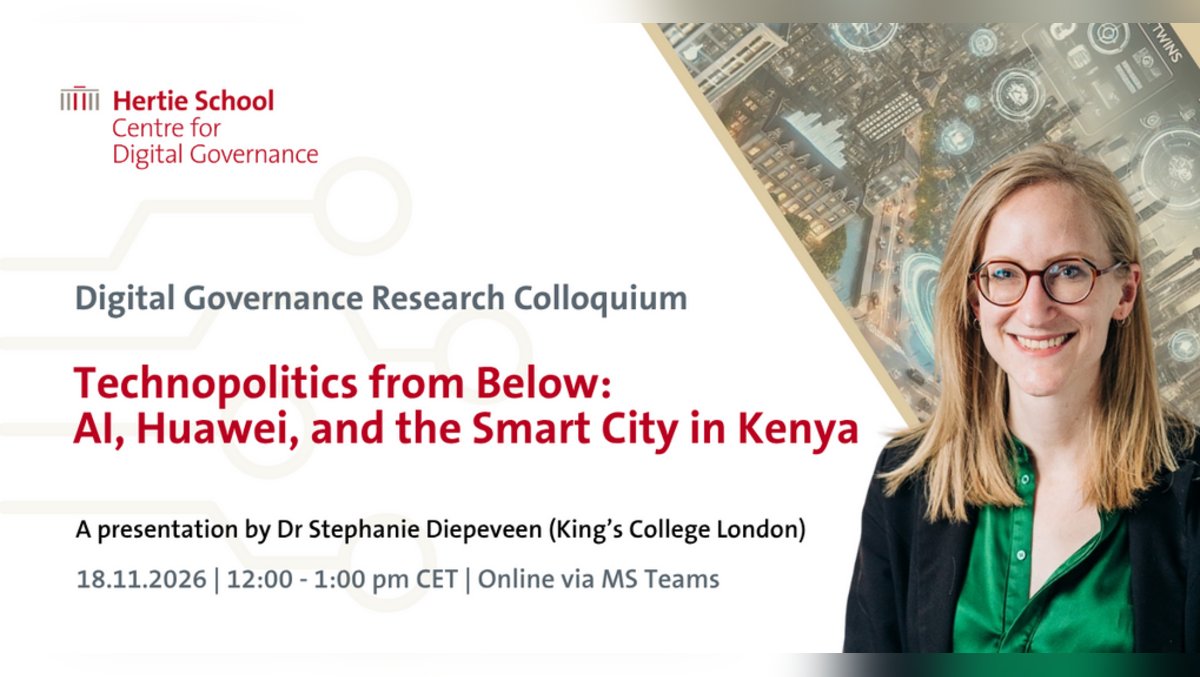
A presentation by Dr Stephanie Diepeveen (King’s College London). This event is part of the Digital Governance Research Colloquium hosted by the Centre for Digital Governance.
Who exercises power over whom with AI? Concerns over AI in the context of political power range from concerns over a growing concentration of power amongst Big Tech and states able to harness AI for rule, to existential concerns that AI will become agents of political power. This talk considers this question through an empirically grounded study into local and global dimensions of power realised through AI-enabled smart city infrastructure in Kenya. Kenya’s AI-powered smart city is deeply entwined with the influence and designs of the Chinese firm Huawei– with the firm integrated into its varied technological layers, from fibre optic cables, to CCTV cameras, and real-time data integration and analysis. Yet, such a focus on the origins and intentions of the technological provider neglect the very real – and critical ways – that the AI-powered smart city as a site of governance, control and contestation is bound up with local histories and politics. Through a technopolitical lens, and drawing on a combination of ethnographic walk-throughs, interviews, and media and documentary analysis, this talk explores how the safe cities project intersects with local configurations of power and skills, reflecting a particular nexus between the international, the national, and the local. Through this, it will argue the political role AI-related technologies play must be understood as emerging first, within longstanding structures of economic and social power, rooted in place, and second, through AI as a set of artefacts that are produced, adapted and used.
Dr Stephanie Diepeveen is a Senior Lecturer in Global Digital Politics at King’s College London, and currently sits as co-chair for the informal Think20 Workstream on Digital Innovation with the US G20, having served previously as a Think20 Taskforce Co-chair under South Africa and India’s G20 presidencies. Her research interrogates the political economy and power dynamics of digital infrastructure, and digitalisation of citizen-state relations, with a focus on eastern Africa.
Registration is required for this event.