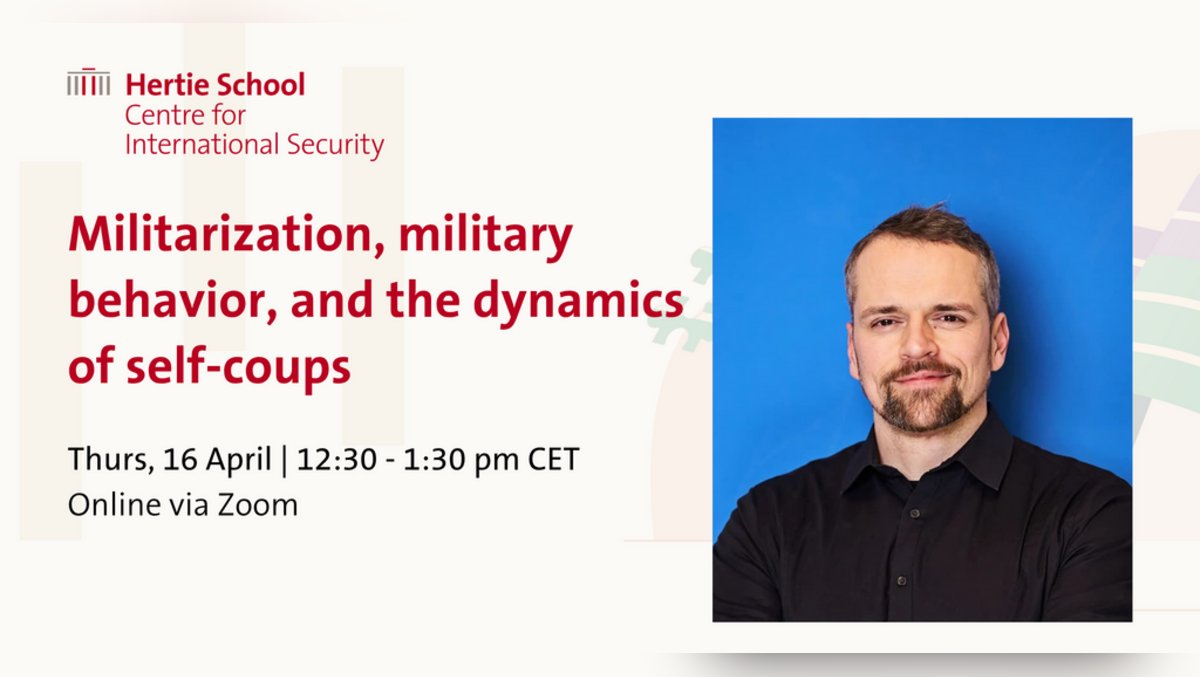
David Kuehn (GIGA Insitute for Asian Studies) presents research examining why some militaries support executive self-coup attempts while others withhold backing, and how these choices shape subsequent trajectories of political militarization.
Political crises surrounding executive self-coup attempts can reveal different patterns of military behavior and their consequences for subsequent political militarization. We argue that pre-coup militarization structures the military’s expectations about the risks and rewards of supporting an incumbent’s power grab. Building on this logic, we propose a non-linear relationship: military support for self-coups is most likely at low and high levels of militarization, but less likely at intermediate levels, where institutional uncertainty is greatest. We further argue that military support is associated with increased post-coup militarization, whereas non-support is followed by stability or decline. Empirically, the paper uses a sequential mixed-methods design combining cross-national statistical analysis of all post-Cold War self-coup attempts through 2024 with qualitative case vignettes of El Salvador (2020) and Türkiye (2016). The findings provide support for the argument that militarization functions both as a precondition shaping military behavior and as an institutional outcome of self-coup crises. The paper thus contributes to research on autocratization, self-coups, and civil-military relations by highlighting the military’s strategic role in moments of democratic breakdown.
This event is part of the International Security Research Colloquium hosted by the Centre for International Security.